Fruit Share Adelaide connects volunteers with unpicked fruit in backyards and smallorchards across Greater Adelaide. By harvesting these crops and delivering them toneighbourhood pantries and food banks, the group reduces urban food waste whileproviding immediate food relief. Using a Risk-Opportunity Analysis, this studyexamines Fruit Share Adelaide as a micro-market shaper, mobilising communityeffort to connect new harvesting capacity and food sources to the GreaterAdelaide food system.
Organisation or group:
Fruit Share Adelaide Incorporated
Legal form:
Incorporated Association (SA CBS A45323) and Registered Charity (ACNC ABN: 45360988434)
Researcher:
Seb Norman
Contact:
Date:
21 October 2026
1. Background
Founded in 2023 and modelled on Ballarat’s The Hidden Orchard, Fruit Share Adelaide Incorporated (FSA) is a volunteer-run charity spanning 22 council areas across Greater Adelaide. FSA steps in whentree owners lack the time, physical mobility, orequipment to pick their fruit (Pollard 2018),rescuing crops before they rot and connectingbackyard trees directly to local fooddistribution groups.
On paper, FSA resembles a micro-nonprofitwith annual cash expenses around $10,000.However, standard accounting hides the realfootprint of this community work. FSAcoordinates more than 500 volunteers throughdigital dispatch tools, matching them toroughly 200 registered residential backyardsand orchards, supplying fresh fruit to over 90local charities and community kitchens, (seeFigure 1).
Grants focused only on cash budgets overlookhow much work this network accomplishes.This case study examines how FSA channelssurplus community volunteer capacity intomeasurable improvements in a region facingfood security challenges (Pettman et al., 2022).
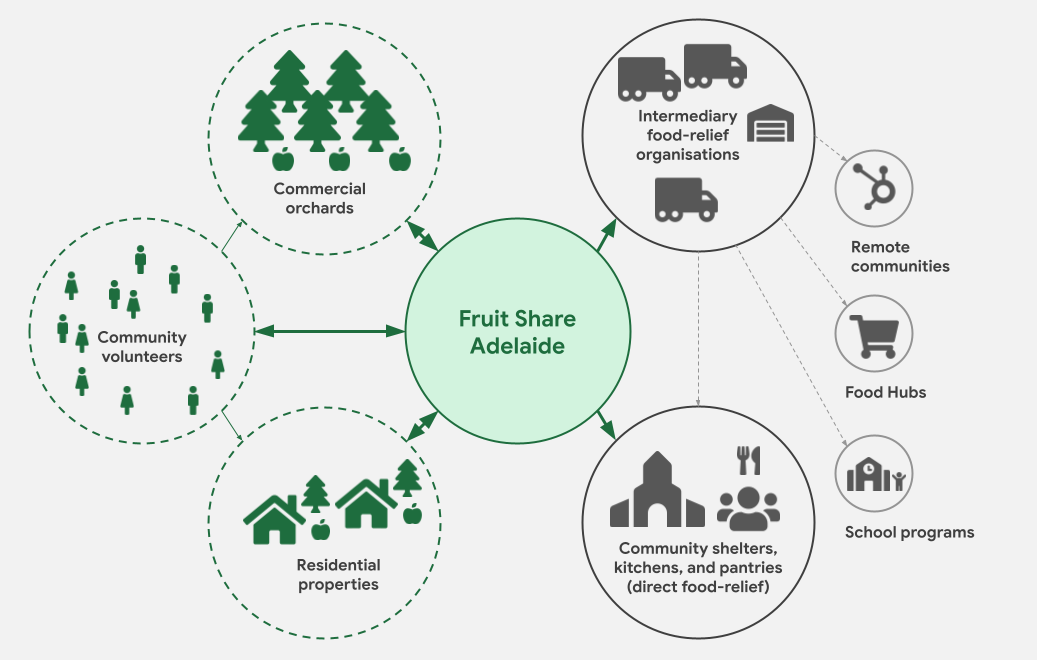
Figure 1: Fruit Share Adelaide ecosystem
2. Theoretical Framework
This study applies Elinor Ostrom's governance principles for shared resources (1990) with complexity economics. Rather than treating suburban backyards as private assets or relying on council mandates, FSA voluntarily manages suburban fruit trees as a shared common resource. The harvest is split three ways: one portion stays with the tree owner, one goes to the volunteer pickers, and the largest share is delivered to frontline food relief agencies.
To evaluate this setup, this study applies Risk-Opportunity Analysis (ROA) (Sharpe et. al., 2021). By mapping the network's boundaries and practical feedback loops, the framework tracks how FSA works across key Sustainable Development Goals: cutting urban food waste (SDG 12.3), lowering food-decay emissions (SDG 13.2), and strengthening local food supply channels (SDG 2).
3. Research Findings
Applying these theoretical frameworks to FSA reveals key insights into how the network balances growth with operational constraints. Their success depends on two main feedback loops that shape how quickly it can grow:
Growth feedback loop (R1): Successful harvests build visibility and trust with neighbours. As more homeowners register their trees because of personal constraints, including ‘lack of time’ (Pollard et al., 2018), picking runs become closer together, making it easier for local volunteers to sign up and harvest more fruit.
Operational constraints loop (B1): As the network grows, coordinating pickers gets harder. Managing site safety, background checks, and gear transport takes significant administrative time. Because volunteer organisers handle this in their spare hours, administrative bottlenecks can slow down response times during peak harvest weeks when fruit ripens quickly.
These two feedback loops create a sensitive intervention point (see Figure 2), where small inputs to FSA’s operational constraints can produce disproportionately large outcomes. (Sharpe et. al., 2021).
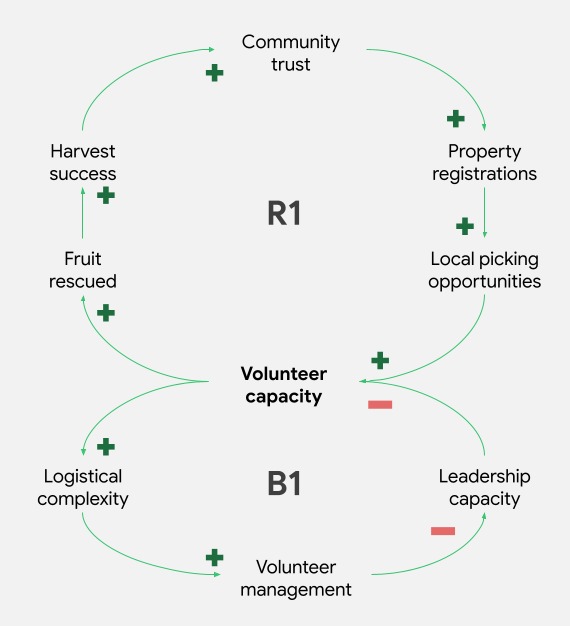
Figure 2: Fruit Share Adelaide feedback loops
Instead of reducing food relief, land stewardship, and community health to a single dollar figure, the ROA framework tracks impact across specific areas:
Environmental Care: Rescued 44,135 kg of fruit from rotting in gardens or landfill (SDG 12.3), preventing an estimated 83.9 tonnes of CO2-e emissions (SDG 13.2).
Sustainable Systems: Delivered over 40,000 kg of fresh fruit directly to 90+ food distribution groups, including Foodbank SA, OzHarvest, SecondBite, Lefevre Community Kitchen and The Hut, helping supply fresh food outside commercial store channels (SDG 2).
Community Connections: Organised 469 harvest events involving over 1,400 direct interactions between volunteers and neighbours, helping connect isolated residents and older homeowners with local volunteers (SDG 3.4).
Systemic Input: Used $16,931 in direct operating costs to mobilise and coordinate roughly 2,700 hours of volunteer harvesting work7, equivalent to $72,000 at the Australian Minimum Wage.
FSA is actively exploring cross-subsidisation to reduce its dependence on traditional grant cycles and limits on volunteer labour. Initiatives include pressing surplus harvested olives into community olive oil and delivering paid public workshops on urban fruit-tree care and seasonal pruning. These workshops create another self-reinforcing feedback loop: by teaching community members to maintain their trees, the model shapes the market, turning passive urban residents into skilled micro-producers, strengthening local horticultural resilience and reducing long-term tree-neglect risks.
4. Discussion
Together, these empirical findings show how targeted micro-investments drive multi-dimensional impact in the Greater Adelaide food system. An ROA framework shows that FSA's main strength lies in better using existing neighbourhood resources. FSA does not fix an existing market failure; it shapes a new polycentric food-rescue commons under conditions of disequilibrium. Meaning it connects new harvesting capacity and food sources to the Greater Adelaide food system.
The ROA also shows how small coordination investments can yield practical returns across multiple areas. Rather than just providing low-cost fruit, FSA builds working ties between volunteers, local councils, and food relief agencies (SDG 17.17). This volunteer setup lets local communities manage seasonal fruit surpluses without building costly permanent facilities.
These findings clearly lay out the practical trade-offs. Core funding of FSA activities directly supports fresh produce supply, reduces local emissions, and strengthens social connection for elderly residents.
5. Limitations
While these findings highlight key successes, evaluating the model's broader applicability requires acknowledging specific methodological limitations.
This evaluation focuses specifically on FSA's operations across 22 council areas in Greater Adelaide, and relies on a single stakeholder interview, self-reported harvest estimates, and secondary desktop research. Additionally, a Social Cost Benefit Analysis8 was undertaken; however, the results have been deliberately excluded on the basis that: 1) they are highly subjective and dependent on assumptions about dead-weight, drop-off, and displacement, and 2) reductionist metric reporting obscures the breadth of impact discussed in Section 3.
Adapting FSA’s model to areas with different volunteer habits or lower digital tool adoption would require localised testing.
6. Conclusion
FSA shows how digital scheduling and local volunteers can turn ungathered backyard fruit into a reliable community supply. Using Risk-Opportunity Analysis, this study highlights how FSA contributes to food waste reduction (SDG 12.3), emissions cuts (SDG 13.2), community connection (SDG 3.4), and local food access (SDG 2).
Administrative drag was identified as the primary operational constraint as the network expands. While digital dispatch tools reduce coordination friction, FSA has reached a conceptual threshold at which administrative workload hampers volunteer growth.
Therefore, supporting FSA's basic dispatch and coordination setup offers a direct way to build a functional, community-led food rescue network.
Notes
The author received no financial support for this research, authorship, and/or publication of this case study.
All financial figures are in Australian dollars.
Declaration of conflicting interests
The author declared no potential conflicts of interest regarding the research, authorship, and/or publication of this case study.
Reference List
Ostrom, E. (1990). Governing the Commons: The Evolution of Institutions for Collective Action. Cambridge University Press. https://doi.org/10.1017/CBO9780511807763
Pettman, T. L., Williams, C., Booth, S., Wildgoose, D., Pollard, C. M., Coveney, J., McWhinnie, J.-A., McAllister, M., Dent, C., Spreckley, R., Buckley, J. D., Bogomolova, S., & Goodwin-Smith, I. (2022). A Food Relief Charter for South Australia—Towards a Shared Vision for Pathways Out of Food Insecurity. International Journal of Environmental Research and Public Health, 19(12), 7080. https://doi.org/10.3390/ijerph19127080
Pollard, G., Ward, J., & Roetman, P. (2018). Typically Diverse: The Nature of Urban Agriculture in South Australia. Sustainability, 10(4), 945. https://doi.org/10.3390/su10040945
Sharpe, S., Mercure, J-F., Vinuales, J., Ives, M., Grubb, M., Pollitt, H., Knobloch, F. and Nijsse, F.J.M.M. (2021). Deciding how to decide: Risk-opportunity analysis as a generalisation of cost-benefit analysis. UCL Institute for Innovation and Public Purpose, Working Paper Series (IIPP WP 2021/03). Available at: https://www.ucl.ac.uk/bartlett/public-purpose/wp2021-03