
Each year, increasing volumes of global capital flow toward mission-driven, public outcomes. However, fragmented terminology, such as “non-profit”, “development organisation”, or “impact investor”, continues to obscure the domains’ coherence and global impact.
Without shared language, the domain operates without shared infrastructure, without coordination incentives, and without consistent institutional recognition. Subsequently, performance is constrained: promising practices diffuse slowly, evidence remains localised, and collective effectiveness is weakened.
This essay argues that the For Purpose domain functions as a distinct mode of economic activity but is constrained by underinvestment in meso-level infrastructure, and cannot be resolved without changing underlying mental models.
What is the For Purpose domain?
Modern economies are typically framed through two coordinating systems: markets and states. Yet a mission-driven, for-purpose system has been operating and growing alongside them, defined strictly by its economic logic: mission primacy, hybrid financing, and structurally diffuse value capture.
This is differentiated from the internationally recognised framework of the Social and Solidarity Economy (SSE). While the two concepts overlap in their commitment to mission primacy and to serving the collective interest, the SSE framework places greater emphasis on sociopolitical mechanisms, including mandating democratic governance, voluntary cooperation, and specific organisational forms such as cooperatives and mutual societies. In contrast, the “For Purpose” domain is defined purely by its economic logic, encompassing any structure that relies on hybrid financing to deliver diffuse public value, regardless of its internal structure.
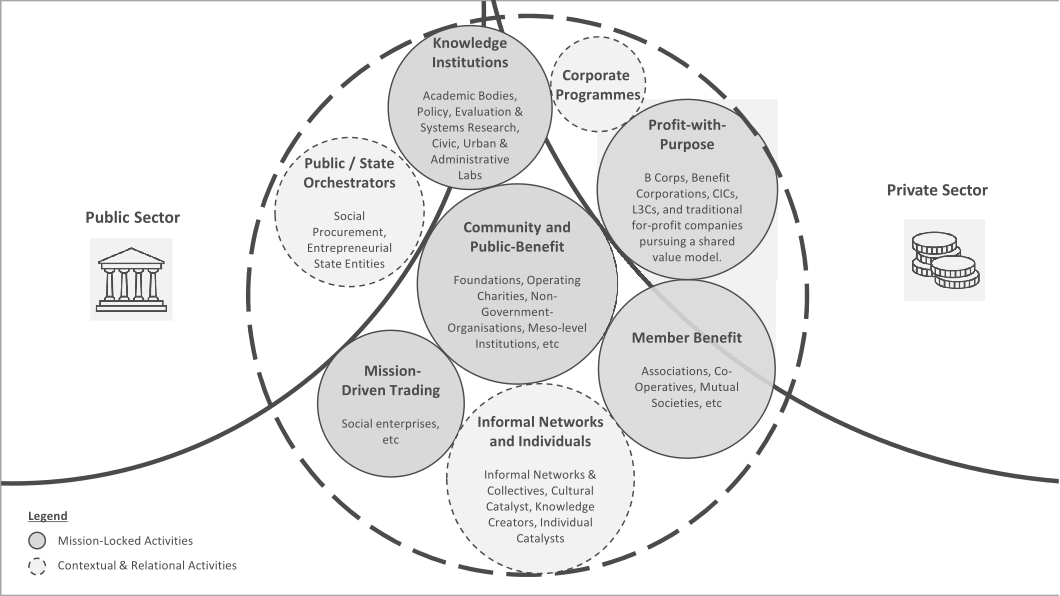
The diagram below illustrates the potential activities within the domain.
An example: Donkey Wheel House, Melbourne
Donkey Wheel House in Melbourne functions as a tangible example of this; operating as a "living commons for changemakers," it provides space and support to 12 tenant organisations, demonstrating how public value is generated and shared structurally through networks rather than captured privately.
Read more
The chronic value creation and capture mismatch
The domain exhibits a fundamental value-creation mismatch: it generates substantial positive spillovers, but only a fraction of that value is captured as investable surplus. This creates a reliance on hybrid financing, combining philanthropic, public, and commercial capital to support mission-driven activities.
A powerful illustration of this value-creation mismatch is the Australian mental health system. The Australian Productivity Commission estimates the economic cost of mental ill-health at up to $220 billion annually. While empirical evidence indicates that early intervention, often delivered by For-Purpose organisations, yields a return on investment of $1 to $10.50 for each dollar spent, structural fragmentation traps capital in downstream, acute state-run responses. This dynamic shows why coordinated mental health early intervention remains chronically underfunded and why the For-Purpose domain must rely on hybrid financing to sustain its mission-driven activities.
However, hybrid financing exposes these organisations to the acute risk of “mission drift“, the gradual prioritisation of commercial goals and financial survival over the foundational social mission. Because these organisations face competing accountability demands from diverse stakeholders, such as financial investors and social beneficiaries, commercial demands can easily eclipse social purpose.
To prevent this, specific governance safeguards must be implemented. For example, the Benefit Corporation (B Corp) legal framework expands directors’ fiduciary duty to require balancing financial returns with stakeholder and environmental interests, while Steward-Ownership models lock in mission primacy by decoupling voting rights from dividend rights.
Fragmentation as a systemic outcome
With limited incentives for coordination, fragmentation emerges not just as a rational coordination failure, but as a profound cognitive and institutional mismatch. Because the societal benefits generated by these organisations are diffuse, individual entities bear the costs of coordination while the benefits accrue broadly, making free-riding structurally embedded. And, this Olsonian trap is compounded by a deeper institutional failure. As Douglass North established, institutions are the rules of the game built upon human cognitive belief systems struggling to make sense of increasing uncertain realities in our modern world. They lower the specific transaction and transformation costs involved in complex exchanges.
In the For-Purpose domain, philanthropic and State orchestrators often operate using outdated mental models, assuming predictable, known leverage points in which systems change can be enabled. They apply these linear thinking approaches to try and navigate the messy reality on the ground. This catastrophic mismatch between explicit top-down metrics and the deeply hidden implicit realities creates severe information asymmetries, trapping the domain in what Joseph Stiglitz identifies as a low-level equilibrium of localised learning. Without shared infrastructure, the sector’s collective effectiveness is systematically weakened by these flawed mental models.
How to break the cycle
Breaking this cycle of fragmentation requires the deliberate construction of meso-level institutions. As Douglass North established in his institutional economics framework, institutions exist precisely to overcome the uncertainties of human interaction and lower the specific transaction and transformation costs involved in complex exchanges. Mature sectors rely on these meso-level institutions, like standards bodies and research networks, to reduce transaction costs and align incentives.
Yet, structural investment alone is not the answer. Systemic fragmentation cannot be resolved without changing underlying mental models. This structural solution must also act as a cognitive intervention: by establishing new rules of the game, meso-level institutions normalise shared purpose and shift underlying assumptions. We must shift the implicit, deeply held assumptions and power dynamics that sustain the current fragmented ecosystem. If the underlying mental models of stakeholders do not genuinely prioritise the social mission, even explicitly designed hybrid legal forms will experience mission drift when new formal rules inevitably clash with an internalised profit-first logic. To break the cycle of fragmentation, the For Purpose domain must actively shape its own narrative and promote an alternative mental model that normalises altruism, shared purpose, and a proactive commitment to collective well-being, turning the inherent “pull to do good” into a powerful coordinating force.
Crucially, this demands a shift in power dynamics and how capital is deployed. Marwell and Oliver showed that when we have critical mass, a highly resourced subgroup of actors will voluntarily absorb start-up costs for accelerative collective goods, thereby snowballing collective action. This casts the role of government and philanthropic orchestrators in a new light. Drawing on Mariana Mazzucato, the State must move beyond merely fixing market failures to actively shape and co-create markets. However, the Entrepreneurial State is not the solitary protagonist or top-down lead, rather, it is a vital cog in a larger symbiotic machine. State and philanthropic orchestrators must act as this critical mass providing the visionary, high-risk patient capital required to absorb pioneer risk. By working in unison with meso-level intermediaries and grassroots networks, they can establish structurally symbiotic ecosystems that protect mission primacy and prevent parasitic value extraction.
I saw this empirically when directing the Victorian Government’s $247 million Sick Pay Guarantee pilot. The State did not just fix a market failure, it acted as the critical mass to absorb the pioneer risk for over 125,000 insecure casual and gig workers who otherwise faced the impossible choice of losing a day’s pay or taking contagious illnesses into the community. Though as a short term pilot fully funded by the government, a pure symbiotic innovation ecosystem was not fully achieved.
The UK Office for the Impact Economy, established in November 2025, is another example that empirically illustrates this by acting as a central orchestrator that aligns capital, policy, and market infrastructure to catalyse system-level coordination without absorbing direct delivery. By functioning as what Ostrom would identify as a nested enterprise this office forces coordination among disparate actors across multiple levels. At the same time, it utilises what Olson refers to as selective incentives to lower synchronisation and transaction costs and mobilise participants who might otherwise succumb to the free-rider problem.
Another example: UK Office for the Impact Economy
The Office for the Impact Economy demonstrates how governments can support coordination in the For Purpose domain. Established by the UK Government in November 2025, it acts as a central function to align capital, policy, and market infrastructure for impact. By convening stakeholders across finance, philanthropy, and enterprise, it reduces fragmentation and supports standard-setting, data development, and capital mobilisation. This approach enables government to catalyse system-level coordination without direct delivery, strengthening market formation and improving the allocation of capital toward measurable social and environmental outcomes.
Read more
Sizing the opportunity
To validate the scale of this economic engine, advocates have historically relied on Gross Domestic Product (GDP). One recent UK study estimated the “Impact Economy” contributes £428 billion, or 15% of GDP in the United Kingdom. Another study estimated that social enterprises alone generate $2 trillion in revenue and support nearly 200 million jobs globally.
However, relying on GDP fundamentally undercuts the true nature of this domain. GDP is an accounting measure of financial flows that fails to capture what is missing: invisible and unpaid labour (such as within the care economy), the depletion of assets like natural resources, and unpriced social costs. As Joseph Stiglitz outlines in his work on market failures, traditional markets systematically under-supply public goods due to imperfect information and diffuse externalities. Relying solely on GDP perpetuates this market failure by ignoring the very externalities the For Purpose domain seeks to resolve.
To accurately capture the scale of this engine, the domain must embrace multidimensional Beyond GDP accounting frameworks. While continuing to quantify macro-level contributions supports policy prioritisation and investment attraction, these metrics must complement, not displace, qualitative and relational forms of value that resist simple monetisation, such as Social Return on Investment (SROI).
Starting the ignition
The For Purpose domain is a massive, multi-trillion-dollar economic engine that remains chronically underutilised. We now know the diagnosis: the fragmentation in the sector is a structural failure precisely because it is driven by flawed mental models attempting to force ergodic, linear compliance (markets and states) onto a non-ergodic, emergent reality (for pupose). And we know the required mechanics: highly resourced orchestrators acting as a critical mass to absorb pioneer risk, unified by digital meso-level infrastructure that lowers transaction costs across policycentric networks.
Yet, a critical gap remains. If the most powerful constraints holding this system in place are deeply hidden, implicit mental models, how do we empirically map them without destroying the very systems emergence we seek to protect? Until we can deterministically classify the informal “rules of the game” operating at the grassroots level, any new infrastructure risks replicating the exact same linear compliance it seeks to replace. The next frontier for the For-Purpose domain is not just acknowledging this cognitive mismatch, but building the privacy-preserving, computational architecture required to measure it, govern it, and ultimately, change it.
Unleashing this domain’s full potential requires moving beyond GDP to accurately value its contributions, investing in meso-level coordination infrastructure, and embracing the proactive role of the Entrepreneurial State. Only through these combined structural and cognitive shifts can we harness this distinct mode of economic activity to deliver public value at scale.
References
Bimber, B., Flanagin, A. J., & Stohl, C. (2005). Reconceptualizing collective action in the contemporary media environment. Communication Theory, 15(4), 365–388.
Cox, M., Arnold, G., & Villamayor Tomás, S. (2010). A review of design principles for community-based natural resource management. Ecology and Society, 15(4).
Kania, J., Kramer, M., & Senge, P. (2018). The Water of Systems Change. FSG.
Lynn, J., & Coffman, J. (2024). Passing in the dark. The Foundation Review, 16(1).
Marwell, G., & Oliver, P. (1993). The critical mass in collective action: A micro-social theory. Cambridge University Press.
Mazzucato, M. (2013). The Entrepreneurial State. Anthem Press.
Mazzucato, M. (2018). Mission-oriented innovation policies: challenges and opportunities. Industrial and Corporate Change, 27(5), 803–815.
North, D. C. (1990). Institutions, Institutional Change and Economic Performance. Cambridge: Cambridge University Press.
North, D. C. (2005). Understanding the process of economic change. Princeton University Press.
Olson, M. (1965). The Logic of Collective Action. Harvard University Press.
Ostrom, E. (1990). Governing the Commons. Cambridge University Press.
Stiglitz, J. (1989). Markets, Market Failures, and Development. American Economic Review.